Not Every Trend Is Your Trend
Why visibility without fit can weaken a brand instead of strengthening it
“Are you building brand equity or renting attention?”

Lately, my social media feeds have been filled with the “farming aura” trend, and it got me thinking about something bigger: trend chasing in marketing.
We are living in a moment where trends move incredibly fast. One day, a phrase, aesthetic, product, or behavior appears everywhere, and almost immediately brands, influencers, and consumers feel pressure to participate.
Sometimes it is fun. Sometimes it creates community.
But sometimes it also feels like a race to stay visible.
And that raises a bigger question:
Are we joining trends because they actually fit us, or because we are afraid of not being noticed?
That question matters even more for brands.
Because not every trend is your trend.
Why brands feel pressure to follow every trend
Social media has dramatically shortened the life cycle of cultural moments.
Something can go from unknown to unavoidable in a matter of days. Brands now operate in an environment where consumers, creators, competitors, and cultural conversations are moving constantly.
Naturally, marketers do not want their brands to feel outdated.
So the temptation is to participate quickly.
Use the sound. Repeat the joke. Recreate the format. Add the trending phrase. Join the aesthetic.
And there is nothing inherently wrong with that.
The problem begins when participation becomes the strategy.
Being present in a cultural conversation can create visibility. But visibility alone does not necessarily
strengthen a brand.
Sometimes it does the opposite.
When every brand follows the same social media trend
We see this constantly on social media.
A sound begins trending on TikTok and within days restaurants, universities, beauty companies, retailers, financial brands, creators, and completely unrelated businesses are all using the same audio and nearly identical joke structure.
For a few days, everyone feels culturally relevant.
But then ask yourself: Who do you actually remember?
Sometimes we remember the trend. We remember the sound. We remember the joke. But we do not remember the brand that posted it.
That is the risk.
Trends create a shared cultural language, and that recognition can help brands capture attention quickly.
But the more companies reproduce the exact same formats, expressions, sounds, and aesthetics, the more difficult it becomes to distinguish one from another.
Try removing the logo from a trending brand post.
Would you still know who created it?
If the answer is no, the brand may be participating in culture without actually strengthening its identity.
And that distinction matters.
Duolingo: when the trend still feels like the brand
Duolingo is a useful example of why trend participation can work when it is built around an established personality.
Its social presence is intentionally playful, chaotic, exaggerated, and heavily centered around its green owl mascot.
So when the brand participates in memes or internet humor, the trend rarely feels like Duolingo suddenly becoming someone else.
Instead, the trend becomes another vehicle for a personality people already recognize.
The trend changes. The character does not.
That is the difference between using trends to express a brand and allowing trends to define a brand.
Brand relevance and brand fit are not the same thing
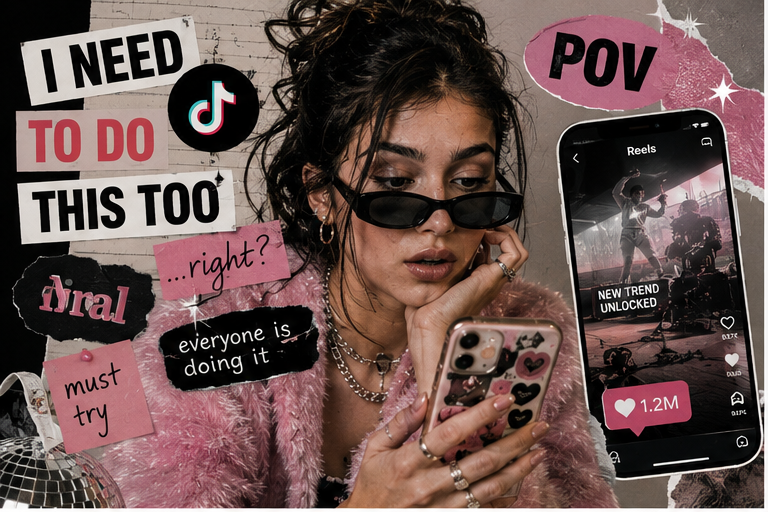
A trend can be extremely relevant culturally and still be completely wrong for a particular brand.
That does not mean the brand is boring. It means the brand understands itself.
Strong brands develop associations over time: personality, tone, values, visual language, customer expectations, and a clear reason for existing.
Every communication decision contributes to those associations.
That means the question should not simply be: “Is this trending?”
It should also be: “Does this make sense coming from us?”
A playful consumer brand may have enormous freedom to participate in internet humor.
A luxury brand may interpret the same cultural moment very differently.
A professional services company may decide that participating adds nothing to the relationship it wants to build with its audience.
None of those decisions are automatically right or wrong.
What matters is fit.
And the pressure is not limited to brands
Consumers experience the same pressure.
Think about how quickly one product can suddenly feel unavoidable.
A particular sneaker. A tumbler. A handbag. A skincare product. A restaurant. A travel destination.
You open TikTok and see it. Then Instagram. Then someone you know buys it. Then another person posts it.
Eventually, people are no longer simply asking: “Do I like this?”
There is another question happening underneath: “Why does everyone else seem to have this?”
That is where trends become more than preferences.
They become signals of participation.
Stanley is a good example
The Stanley tumbler is useful here because the product itself is incredibly simple.
It is a drinking vessel.
But through color releases, social visibility, creator culture, collectability, and constant online exposure, the product became more than its functional purpose.
It became a recognizable lifestyle object.
People were not only buying hydration. They were also buying into a cultural moment.
That is one of the most powerful things trends can do.
They can transform an ordinary product into a symbol of belonging.
And when that happens, brands watching from the outside may feel pressure to create their own version of the moment.
But copying the visible element is not the same as understanding why the phenomenon worked.
Bedazzling offers another example
Rhinestones were not invented by the current internet cycle.
The aesthetic already carried strong associations with Y2K fashion, pop culture, accessories, phones,
clothing, and beauty.
What changed was its visibility.
Once highly visible celebrities and creators began bringing the aesthetic back into the conversation,
bedazzling started appearing across cakes, nails, phone cases, drinks, accessories, and content.
Something familiar became culturally relevant again.
And suddenly brands and creators had a decision to make:
Is this something we can reinterpret naturally?
Or:
Are we participating simply because everyone else is?
Those are very different motivations.
Even “farming aura” tells us something
At its simplest, “farming aura” assigns imaginary social points to things that make someone appear confident, stylish, effortless, impressive, or cool.
Lose your composure? Minus aura. Do something unexpectedly smooth? Plus aura.
It is funny because the points are imaginary.
But the concept also reflects something very real about modern culture:
visibility and perception have become forms of social currency.
And brands exist inside the same environment.
They are constantly being watched, evaluated, compared, shared, and interpreted.
When visibility starts feeling like currency, participating in everything can begin to feel necessary.
But that is exactly when strategy becomes more important.
Social media attention is not the same as brand equity
This is where marketers can become distracted.
A trending post might produce more views, more comments, more shares, more impressions, or even a temporary increase in followers.
Those numbers can feel exciting.
But attention and brand building are not automatically the same thing.
The more important question is:
What did people remember about the brand after the attention disappeared?
Did the trend reinforce what the brand stands for?
Did it make the brand more distinctive?
Did it attract the right audience?
Did it strengthen an existing association?
Did it move people closer to considering or choosing the brand?
Or did it simply create a few seconds of visibility?
Short-term engagement can look impressive while contributing very little to long-term positioning.
The fear of sitting one out
Perhaps one of the hardest things for brands today is accepting that they do not need to participate in everything.
When competitors are posting about a trend, staying silent can feel like missing an opportunity.
But restraint can also be strategy.
A brand that knows when not to participate demonstrates something valuable: clarity.
It understands its audience. It understands its personality. It understands what deserves attention and what does not.
There is confidence in that.
Brands do not become culturally relevant by reacting to every cultural moment.
They become relevant by understanding which moments they actually have a meaningful reason to enter.
How brands should decide whether to follow a trend
1. Does this make sense for our audience?
A trend may be everywhere and still be irrelevant to the people the brand is trying to reach.
Visibility among the wrong audience is not automatically valuable.
2. Does it fit our brand personality?
Imagine the content without the logo.
Would the tone still feel like your brand?
If participation requires temporarily becoming a completely different personality, that may be a warning sign.
3. Can we add something to the conversation?
Simply recreating what thousands of other accounts have already done rarely creates meaningful
differentiation.
The strongest trend participation contains something that could only have come from that particular brand.
4. What are we actually trying to accomplish?
Is the objective awareness? Engagement? Community building? Brand personality? Product discovery?
A trend should support an objective.
The trend should not become the objective.
5. Will this still make sense after the trend disappears?
Not every post needs to be evergreen.
But every post contributes something to how people perceive a brand.
Ask whether that content strengthens or weakens the identity being built over time.
6. If we remove the trend, is there still something recognizably ours?
This may be the most important question.
Remove the trending audio. Remove the meme. Remove the phrase. Remove the aesthetic.
What is left?
If nothing distinctly belongs to the brand underneath it, then the brand may not be building equity.
It may simply be renting attention.
Participate, but translate
The answer is not for brands to ignore trends.
Cultural participation can make brands feel alive, responsive, and connected to their audiences.
The opportunity is to translate the trend through the brand, rather than translating the brand into
whatever happens to be trending.
There is a major difference.
One approach asks: “How do we copy this?”
The other asks: “How would our brand interpret this?”
That second question leaves room for identity.
Maybe the trend becomes educational. Maybe it becomes humorous. Maybe it becomes visually distinctive.
Maybe the brand connects it to a product insight. Maybe it responds in a way nobody else could.
And sometimes the strongest interpretation is simply: We are sitting this one out.
The brands people remember are not the ones that followed everything
Marketing has always required relevance.
But relevance without consistency can become noise.
Consumers do not build strong relationships with brands simply because those brands appeared in every trending conversation.
They remember brands because, over time, those brands become associated with something recognizable.
A perspective. A feeling. A personality. A promise. A distinctive way of showing up.
Trends can amplify those things.
They should not replace them.
So the next time something begins taking over your feed, maybe the first question should not be: “How quickly can we join?”
Instead, ask: “Does participating in this make our brand more recognizable – or just more visible?”
Because there is a difference.
And not every trend is your trend.
Now, Are you building brand equity or renting attention?
Written by Mariana Reategui | Digiblonde